
The experiences of five Army reservists of the 1st Bn, Hampshire Regiment (Aug 1914-Nov 1914)
At the outbreak of the First World War in August 1914, five men originating from the rural parish of St Mary Bourne, Hampshire, were recalled from the Army Reserve to rejoin the Hampshire Regiment and deploy overseas with the British Expeditionary Force.
This research reconstructs the service, family backgrounds and wartime experiences of these five reservists: Frederick George Day, Sydney Gunnell, Edwin Pike, Walter Sims and James Pike.
The investigation began at the St Mary Bourne War Memorial, where identifying the regiment shared by the five men revealed that all had served with the 1st Bn, Hampshire Regt. Family history sources including census returns, parish registers and attestation papers were searched using standard genealogical databases to trace their civilian lives and identify surviving Military Records. To build a clearer picture of their experiences, the war diaries of the regiment and adjacent regiments such as the 1st Bn, Somerset Light Infantry and the 1st Bn, Rifle Brigade, were cross-referenced. Contemporary local newspapers and diaries from other soldiers add to the picture that is compiled during this research.
All five men had completed prior regular service in the Army before returning to civilian life and joining the Army Reserve. Through the surviving historical and family evidence, this research traces their journey from a quiet Hampshire harvest to the Western Front, preserving the memory of how each man lost his life.
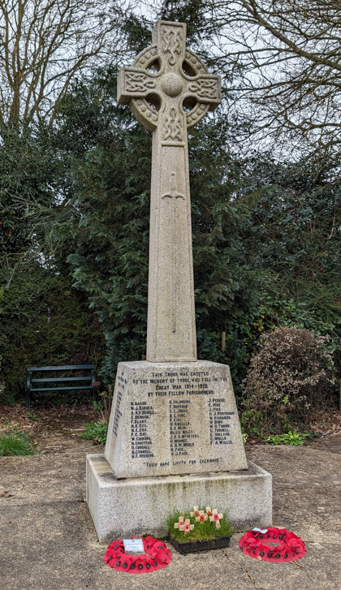
August 1914: The Return to the Colours & The Retreat from Mons
When Britain declared war on Germany on 4 August 1914, official mobilisation notices appeared in national and local newspapers calling Army Reservists back to their regiments.
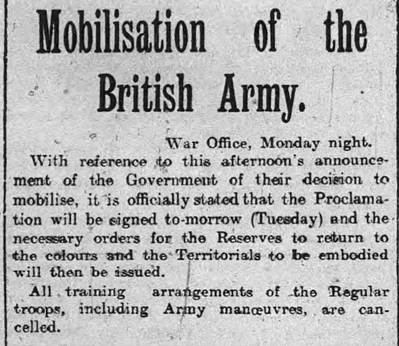
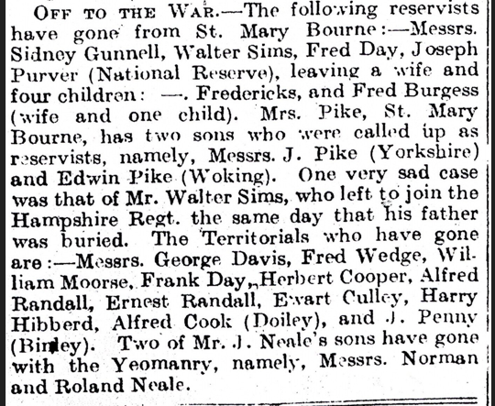
The five men from St Mary Bourne held different reserve classifications based on how recently they had completed their regular army service. James Pike, Sydney Gunnell and Frederick Day had left active service only two or three years earlier, placing them in the Class B reserve. In contrast, Edwin Pike and Walter Sims had been out of the regular army for eight or nine years, placing them in the Class D reserve. This difference in reserve status directly influenced when each man was dispatched to the front lines. As reservists, all five were required under Army regulations to complete periodic refresher training throughout their period on the reserve.
The sudden recall struck a heavy blow in the parish, coming right at the start of the harvest season. A contemporary report in the Andover Advertiser highlighted the immediate local impact:
“MOBILISING – The calling up of the reserve and territorials had had a saddening effect upon St. Mary Bourne, as men are very helpful at this, the harvest season.”3
Mobilisation proceeded at remarkable speed. Local press notices record that Walter Sims left St Mary Bourne to rejoin the Hampshire Regiment on 5 August 1914, the day of his father’s funeral and just one day after the declaration of war.
Upon receiving their orders, the men made their way to the Hampshire Regiment Depot at Winchester. There they were kitted out with uniform and equipment and underwent brief refresher training before being assigned to the 1st Bn, Hampshire Regt.
On 22 August 1914, the 1st Bn, Hampshire Regt assembled at Southampton Docks and embarked for France aboard two ships, the Braemar Castle and the Cestrian. The initial draft included Frederick Day, James Pike and Sydney Gunnell. After crossing the English Channel, they disembarked at Le Havre to join the British Expeditionary Force.
Travelling on the same ships were the 1st Bn, Somerset Light Infantry. Private Arthur Cook of this regiment recorded their arrival in his diary, capturing the atmosphere that Frederick, James and Sydney would have experienced as they stepped onto French soil:
“We are now on French Soil and had a great welcome from the French people. We marched from the Docks to a camp on the top of a hill, which we reached about 3.30 a.m., and anchored down for asleep . We were given two Oxo tablets and emergency rations. We were told that on no account should we use these unless told to do so by an officer. We cooked our own meal of bacon, bread and tea and were told to get as much rest as possible”5
From Le Havre, the troops moved forward by rail towards the Front. Private F. G. Pattenden of the 1st Bn, Hampshire Regt described the gruelling journey in his diary:
“August 24th 1914. (Monday). We are now waiting at Havre Station to begin our 12 hours ride to somewhere. It is very hot here. We started at 12 p.m. and after 16 hours of grinding and bumping, roar and rattle we have now reached the town of Le Cateau about 30 miles from the frontier. We do not know where we move to next.”6
The Battle of Le Cateau and the Retreat from Mons
Within days of arriving in France, Frederick, James and Sydney were thrust into active operations covering the retreat of the British Expeditionary Force under heavy pressure from the advancing German First Army. Unlike Edwin Pike and Walter Sims, who were veterans of the Second Boer War, these three younger men had served their regular enlistments during peacetime and were entering combat for the first time.
On 26 August 1914, II Corps made a major defensive stand at Le Cateau. Private Pattenden captured the chaos and intense shellfire of the battalion’s “baptism of fire” in his diary:
“August 26th 1914. (Wednesday). Written at 5 a.m. after 2½ hours of well-earned rest by the road side. We done a night march from about 7 p.m. to 2 or 3.15 o’clock. We are in Beauvais waiting for work to begin. Our march was illuminated by the flare of burning houses fired by Germans. We are having our baptism of fire. We began fighting at 5 a.m. It is fearful and we have a few wounded, the shrapnel shell is the chief cause. I have just been to Ligny for ammunition at 9 a.m. Still fighting hard, our guns have silenced the enemy for a while. We are now waiting for the 10th and 12th Brigades to support us. The noise at times is fearful. We marvellously escaped annihilation, we had to retire and they caught us with shrapnel, it was nearly a wholesale rout and slaughter. Poor old Kennard is dead. We also just managed to sneak from Ligny, the French arrived and saved us.”7
That single day of heavy fighting cost the 1st Bn, Hampshire Regt, 3 officers and 6 other ranks killed, 5 officers and 126 other ranks wounded and 2 officers and 40 other ranks missing. Although fighting continued through the remaining days of August, no further casualties were recorded before the month ended.
September 1914: The Battle of the Marne & The Aisne
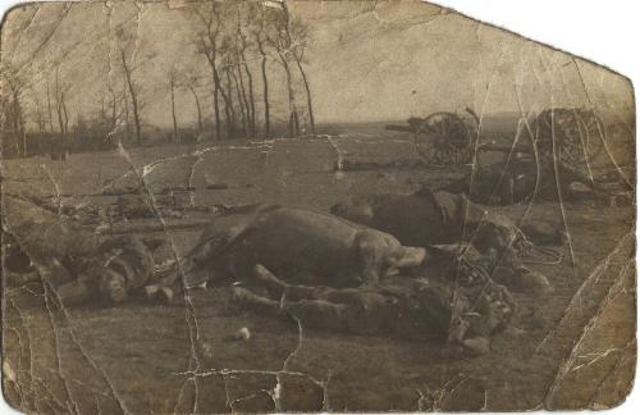
Early September saw the 1st Bn, Hampshire Regt continuing the gruelling retreat they had joined upon arrival in France. On 1 September 1914, the battalion came under heavy fire from dismounted Uhlans (German light cavalry), though the War Diary recorded no casualties.
By 5 September, after nearly a fortnight of near-constant marching, the physical and emotional strain on the men was severe. Private F. G. Pattenden of the 1st Bn, Hampshire Regt captured the exhaustion and frustration in his diary entry for that day:
“September 5th 1914 (Saturday). We are halted here by the roadside and have been since 12 a.m. we dont know where we are or where we go we are worse off than sheep. Written at 2.30 p.m. in the town of Gritz-Armainvillers after 9½ hours marching. We have once more been deceived again. For a fortnight we have been fed on lies, lying tales buoying us up with false hopes as to mileage and results of battles. They have told us our marches have been strategical, all lies it is nothing more or less than a complete retreat and for a fortnight we have had to flee, because we fear to be utterly outclassed and beaten and now if we are attacked what hopes we have we could not run a dozen yards and the result would be a bloody slaughter. Has the British public been told of our movements, of the disgraceful mistakes made by regiments, not much I guess. August 26th we began to retreat and have not finished yet, can flesh and blood stand this, no there is even a limit to human endurance and I have reached my limit and to go farther for a time I cannot. We are alone here in this place as reserves. I hope all will be safe.”9
Frederick Day, James Pike and Sydney Gunnell would have shared those same feelings of physical exhaustion. That same day, 5 September, the battalion received its first draft of reinforcements, consisting of one officer and 52 other ranks. Among them was Edwin Pike, who arrived at the front lines no doubt eager for news of his younger brother, James.
The Battle of the Marne
Between 6 and 12 September 191410, the Allies mounted a major counter-offensive along the River Marne, halting the German advance towards Paris. On 9 September, as the 1st Bn, Hampshire Regt crossed the Marne at La Ferté, two men accidentally drowned11 during the river crossing.
Private Edward Roe of the 1st Bn, East Lancashire Regt described the tense experience of crossing the river in his diary:
“At 5.30 pm we receive orders to cross the river. We file down past our barricade and reach the end of the village street. The river is on our right. There is no pontoon bridge, but an old Frenchman has ‘dug up’ a couple of boats. Together with a couple of pontoons they soon get us across.12 We expected to get ‘seen off’ by machine gun fire, yet not a shot was fired in opposition. Has he cleared off?”12
The Battle of the Aisne
From 12 to 15 September 1914, the battalion held positions near La-Montagne Farm, occupying newly dug trenches. The weather was very wet and the trenches were subjected to continuous German artillery bombardment. Between 13 and 17 September, 11 other ranks had been killed, two officers and 54 other ranks were wounded, all by Artillery fire.
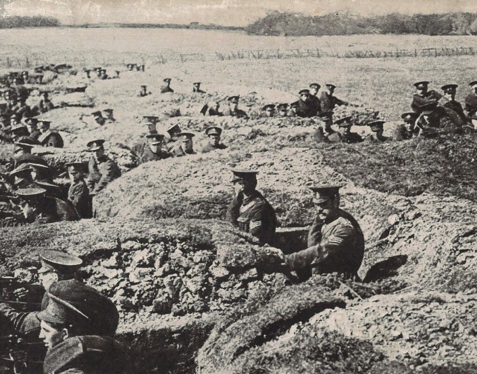
Private Pattenden recorded the wretched weather conditions in his diary entry for 12 September:
“September 12th 1914 … We are still wet through, my clothes are full of sand and mud but, thank God, I am still alive…”14
James, Frederick, Sydney & Edwin would have been in an identical plight, drenched and exhausted, but thankful to have survived the opening month of the war.
Around 24 September 1914, while the battalion was still holding positions near La-Montagne Farm, the third draft of reinforcements arrived from England. Among them was Walter Sims, who had left St Mary Bourne seven weeks earlier following his father’s funeral. Having missed the early mobile battles of August, Walter now joined his fellow villagers in the emerging routine of trench warfare.
As the front lines stabilised, conditions gradually improved regarding food supply and equipment, as described in the regimental history:
“Sleeping in the open, often on wet ground, with no chances of a change of clothing and the scantiest opportunities of washing, did not seem to disagree over much with the men’s health, and once the retreat was over rations were plentiful and good. With the troops stationary in trenches, mails and parcels containing many ‘comforts’ could be delivered regularly, while large supplies of clothing and equipment arrived, including two machine guns, and the battalion was soon pretty well refitted, though boots were slow to appear.”15
October-November 1914: The Move to Ploedsteert Wood
By mid-October, the battalion had moved north as the front lines extended towards Flanders. The War Diary records the their advance from Bailleul towards Nieppe, Armentières and ultimately into the damp, heavily wooded sector of Ploegsteert Wood (“Plugstreet Wood”):
“16 October – The battalion advanced from Bailleul towards Nieppe with B Company leading, A Company in reserve, and C and D Companies covering the flanks. By 10:00 pm, Nieppe was secured without opposition.
17 October – Very thick mist that day. Improvement of defences continued with reconnaissance, confirming German forces held a barricaded bridge at Pont de Nieppe. At 4:10 pm, supported by artillery, machine-gun, and rifle fire, the battalion advanced and took the village and bridge as the enemy withdrew with light resistance.
18–19 October – German forces retreated towards Lille; the battalion advanced into Armentières and billeted at the railway station, remaining in reserve the following day.
20 October – While taking up support positions behind the 10th Brigade, C Company came under shell fire, suffering five casualties (two killed and three wounded).
21 October – The battalion withdrew temporarily to the Armentières Asylum before redeploying in stages towards Ploegsteert. B and C Companies occupied trenches along the St Yves–River Douve line, A Company relieved the King’s Own Regiment near Le Touquet Station, and D Company and HQ billeted at Ploegsteert.
22 October – In the early morning, additional trenches were taken over at Le Touquet under an aborted enemy advance, with zero casualties. By the end of the day, the full battalion reconcentrated at Ploegsteert to entrench a supporting line across PI 63 and Bois de Ploegsteert.”16
Frederick Day served in B Company, placing him at the front during the advance on Nieppe on 16 October, while Edwin Pike served with D Company covering the flanks.
The Defence of Ploegsteert Wood
The fierce fighting that followed between 28 October and 2 November 1914 tested the battalion severely, as described in records preserved by the Royal Hampshire Regiment Museum:
“The 1st Hampshire relieved the Somerset Light Infantry to the east of Ploegsteert Wood on 28th October 1914. Strung out along more than 2,000 yards, virtually the whole battalion found itself in the firing line. After repulsing an attack on Le Gheer on 29th October, 1st Hampshire came under ferocious German bombardment early the following morning. This barrage continued with varying intensity throughout the day and the Hampshire trenches and their garrisons suffered heavily. However, the men held on and during the morning their riflemen wreaked havoc among assaulting enemy troops.
The most dangerous attack came at about 4.30pm when the Germans swarmed forward in masses … No. 10 Platoon of C Company … was occupying an isolated trench some 20 yards in front of the main line and came under particularly heavy bombardment. The platoon, however, clung on tenaciously and took a heavy toll on the enemy before being killed or taken prisoner almost to a man…
Despite taking heavy casualties the Germans made inroads in the centre of the Hampshire line and threatened to break right through. They were prevented from doing so by the [2] platoons … and also C Company … which threw up a barricade across the end of a trench and set up a machine-gun which they used to pour enfilade fire on the Germans in the captured stretch of line next to them.
That night much of the line was re-dug and the battalion benefited from these improvements the next day when German artillery mounted another tremendous bombardment, followed by a fresh infantry attack. The attackers reached the wire in front of the Hampshire line but were again driven back having suffered heavy losses – 75 bodies were counted in front of one short stretch of trench alone.
Renewed German attacks over the following two days were also successfully repulsed and 1st Hampshire were eventually relieved on the evening of 2nd November … ”17
Private Arthur Cook of the 1st Bn, Somerset Light Infantry recorded the sheer intensity of the bombardment during those days in his diary:
“2 Nov 1914 … Another day of Hell under the continual hail of shells and bullets. Why have we no artillery to retaliate? Men are being buried alive and blown to pieces all around me. Perhaps death is preferable to this infernal life…”18
Throughout November, the battalion remained in the vicinity of Ploegsteert Wood, continuously repairing waterlogged trenches while under constant threat from enemy marksmen. The War Diary entry for late November noted:
“19th to 30th Nov – Nothing of importance happening during this period Bn employed daily in improving defences. German Snipers very active and were the cause of all our casualties …”19
While the War Diary described the period as having “nothing of importance happening”, for two families in St Mary Bourne, these weeks brought devastating news.
Private Frederick George Day (1888-1914)
1st Battalion, Hampshire Regiment (Regimental No. 7422)
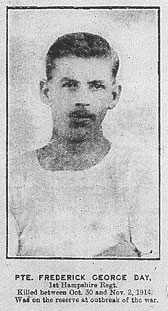
Frederick George Day was born in St Mary Bourne on 6 February 188820, the eldest son of George Day and his wife Sarah Ann (nee Smith). Baptised at Primitive Methodist Chapel, St Mary Bourne on 22 March 188821, he grew up in the parish alongside his three siblings and worked locally as a farm labourer for Mr W. Watts at Jamaica Farm.
On 5 January 190522, shortly before his eighteenth birthday, Frederick attested for six years’ service with the 3rd Bn, Hampshire Regt, before transferring to the 2nd Bn. During his regular service, he deployed to South Africa, serving at Wynberg23 alongside fellow St Mary Bourne native James Pike. On 25 January 1912, he completed his active service, returned home to Hampshire and was placed on the Army Reserve.
Recalled to the colours in August 1914, Frederick was posted to the 1st Bn and disembarked at Le Havre on 23 August. Serving in B Company, he endured the Retreat from Mons, the Battle of Le Cateau, the Marne and the Aisne trenches.
During the heavy bombardment of Ploegsteert Wood, Frederick was killed in action between 30 October and 2 November 1914 at the age of 26. He was the youngest of the five reservists and the first to fall. His last postcard home was dated 29 October 1914.
Having no known grave, Private Frederick Day is commemorated on the Ploegsteert Memorial in Belgium. He was posthumously awarded the 1914 Star, the British War Medal and the Victory Medal24.
A contemporary report in the local press recorded the parish’s grief:
“From Belgium.—We regret to announce that Mr. and Mrs. George Day, of Lower Rank, has this week received official information that their eldest son, Fred, of the 1st Hampshire Regt., has been missing since Oct. 3[0]. The information bears the usual formal notice that this does not necessarily mean that he is killed or wounded, but might have been taken prisoner or cut off from his regiment. Mr. and Mrs. Day have another son on duty with the forces, but this one, Frank, of the Wessex A.S.C., is at present in the home camp.”25
Following confirmation of his death, the village gathered at St Peter’s Church:
“It was reported in these columns some weeks agao that this young man was missing and his parents have now received notice from the officer in charge of Records, Exeter, that he was killed in action between Oct. 30 and Nov. 2. It might be mentioned here that he sent a postcard under date Oct. 29. At the service at the parish church on Sunday his relatives and friends in attended as a mark of sorrrow, respect and esteem… In the course of his sermon Rev. P. E. Binns said they had not received any details about the young man’s death but they might be sure he fell doing his duty as a brave soldier should. He was a good workman, one such as helped to make the backbone of England. He was a lover of home, and one in whom his family rightly took pride. He could not have chosen a better death than to die in defence of his country … The deceased who was in the 1st Hants, came home from South Africa with Gunnell on Jan. 25, 1912 and was also on the reserve at the time the war broke out…”26
Private Sydney Gunnell (1885-1914)
1st Battalion, Hampshire Regiment (Regimental No. 7389)
Sydney Gunnell was born in St Mary Bourne on 15 November 188527, the son of Thomas Gunnell and his wife Mary Jane (nee Goodyear). Baptised at the parish church on 23 April 188628, he was raised in a large family of twelve children.
Sydney enlisted in the Hampshire Regiment in late 190429. Deployed to South Africa with the 2nd Bn, Mounted Infantry30 at the Kings Hill garrison in Harrismith, he was a keen cricketer who played in the team that won the Harrismith Garrison League in 1911. Upon his transfer to the Army Reserve on 25 January 1912, he returned to St Mary Bourne, working as a local labourer, playing for the village cricket club and serving as an active member of the St Mary Bourne Fire Brigade.
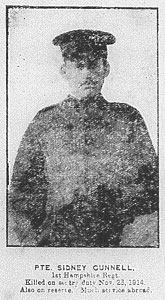
Mobilised in August 1914, Sydney served with the 1st Bn through the opening campaigns at Le Cateau, the Marne and the Aisne. On 23 November 1914, while on sentry duty in the trenches at Ploegsteert Wood, Sydney was killed by a German sniper. He was 29 years old.
He lies buried at Lancashire Cottage Cemetery in Belgium. Posthumously awarded the 1914 Star with Clasp and Roses, the British War Medal and the Victory Medal31, Sydney was honoured back home by his fellow firemen, who attended his memorial service:
“KILLED IN ACTION. — We greatly regret to record the fact that news has reached St. Mary Bourne that Pte. Sydney Gunnell, of the 1st Hants Regt., was killed while on sentry duty on Nov. 23. As the deceased was a very well known and popular man in village life it was felt that something should be done in the way of a memorial service, but there being only one relative now residing in the village it was decided to ask the Fire Brigade (of which Gunnell was a member) to attend the service on Sunday morning at church as a mark of their respect and esteem, and this they did. The organist, Mr. A. H. White, played as a voluntary “O Rest in the Lord” at the beginning of the service, and in the course of his sermon on the text “Greater love hath no man than this: that a man lay down his life for his friends,” the Rev. P. E. Binns said that quite literally Gunnell had laid down his life for others through being shot on sentry duty. They had thereby lost one of the brightest and best. They respected him as a good son and an ideal brother. He was a faithful soldier and an honest workman. Further, he set a fine example as a fair, sportsmanlike cricketer, quiet in manner and upright in life. At the close the two prayers from the Burial Office were read, and the hymn “They whose course on earth is o’er” was sung. What tends to make this loss the more unfortunate is the fact that Gunnell had not long returned from South Africa and had left the Army, but had to serve some time on the Reserve. The whole village are truly sorry to hear the sad news, and their sympathies, together with those of a large number of the district cricketing fraternity, go out to the relatives in what must be to them an irreparable loss.”32
- Photograph taken by Julie Muirhead, 16 Mar 2024 ↩︎
- 4 August 1914, Mobilisation of the British Army (Pg. 3), notice, Southern Daily Echo, Southampton, online, www.newspapers.com, accessed: August 2026 ↩︎
- 7 August 1914, St Mary Bourne, Andover Advertiser, Andover, microfilm, accessed: 2014 ↩︎
- 7 August 1914, St Mary Bourne, Andover Advertiser, Andover, microfilm, accessed: 2014 ↩︎
- Gillard, B. (2004). Good Old Somersets, An ‘Old Contemptible’ Battalion in 1914. Leicester: Matadoor, pp. 7. ↩︎
- Pattenden, P. (1914). Diary of Private F.G. Pattenden (Aug 1914 to Sep 1914), from the 1st Bt. Hampshire Regiment War Diary. The National Archives. Retrieved from www.ancestry.co.uk ↩︎
- Pattenden, P. (1914). Diary of Private F.G. Pattenden (Aug 1914 to Sep 1914), from the 1st Bt. Hampshire Regiment War Diary. The National Archives. Retrieved from www.ancestry.co.uk ↩︎
- https://www.longlongtrail.co.uk/battles/battles-of-the-western-front-in-france-and-flanders/the-retreat-from-mons-and-the-battle-of-le-cateau/ ↩︎
- Pattenden, P. (1914). Diary of Private F.G. Pattenden (Aug 1914 to Sep 1914), from the 1st Bt. Hampshire Regiment War Diary. The National Archives. Retrieved from www.ancestry.co.uk ↩︎
- https://www.royalhampshireregiment.org/about-the-museum/timeline/1st-hampshire-marne-aisne/ ↩︎
- Officers of the 1st Bn. The Hampshire Regiment. (Aug 1914-Apr 1915). War Diary of the 1st Bn. The Hampshire Regiment. The National Archives. Retrieved from www.ancestry.co.uk ↩︎
- Roe, E. (2004). Diary of an Old Contemptible (Kindle ed.). (P. Downham, Ed.) Barnsley: Pen & Sword Books, Chapter IV. ↩︎
- https://thehistorypress.co.uk/article/the-first-trenches-of-the-first-world-war/ ↩︎
- Pattenden, P. (1914). Diary of Private F.G. Pattenden (Aug 1914 to Sep 1914), from the 1st Bt. Hampshire Regiment War Diary. The National Archives. Retrieved from www.ancestry.co.uk ↩︎
- Atkinson, C. (1952). The Royal Hampshire Regiment 1914-1918 (Kindle ed., Vol. Two). Glasgow: The University Press, Chapter II. ↩︎
- Officers of the 1st Bn. The Hampshire Regiment. (Aug 1914-Apr 1915). War Diary of the 1st Bn. The Hampshire Regiment. The National Archives. Retrieved from www.ancestry.co.uk. Note: this is a summary of the actions during the period. ↩︎
- https://www.royalhampshireregiment.org/about-the-museum/timeline/defence-ploegsteert-wood/ ↩︎
- Gillard, B. (2004). Good Old Somersets, An ‘Old Contemptible’ Battalion in 1914. Leicester: Matadoor, pp.105-106. ↩︎
- Officers of the 1st Bn. The Hampshire Regiment. (Aug 1914-Apr 1915). War Diary of the 1st Bn. The Hampshire Regiment. The National Archives. Retrieved from www.ancestry.co.uk ↩︎
- Frederick George Day, Birth Certificate, registered: Q1 1888 Whitchurch (Hampshire), Vol. 2C, Pg. 208, General Register Office. ↩︎
- Frederick George Day, baptism, 1888, Andover Primitive Methodist Circuit, Hampshire, England, Nonconformist Registers, 1835-1921 (available at www.ancestry.co.uk), 96M72/NMC/R8, original data: Hampshire Archives & Local Studies, accessed: February 2026. ↩︎
- Frederick Day, British Army Service Records (available at www.findmypast.co.uk ), original data: The National Archives, Regimental No. 1031, Hampshire Regiment, Attested: 5 Jan 1905, WO 96/644 box 55, accessed: February 2026. ↩︎
- Frederick Day, 1911 Census for England & Wales (available at www.findmypast.co.uk), reference: RG14 piece 34976, schedule 9999, original data: The National Archives, accessed: February 2026. ↩︎
- Frederick Day, UK, British Army World War I Medal Rolls Index Cards, 1914-1920 (available at www.ancestry.co.uk ), original data: The Western Front Association, Regimental No. 7422, Hampshire Regiment, accessed: February 2026. ↩︎
- 4 December 1914, St Mary Bourne, announcement, Andover Advertiser, Andover, microfilm, accessed: 2014 ↩︎
- 25 December 1914, St Mary Bourne (article very faded), announcement, Andover Advertiser, Andover, microfilm, accessed: 2014 ↩︎
- Sydney Gunnell, Birth Certificate, registered: Q4 1885 Whitchurch (Hampshire), Vol. 2C, Pg. 209, General Register Office. ↩︎
- Sidney Gunnell, baptism, 1886, St Mary Bourne, Hampshire, England, Church of England Baptisms, 1813-1921 (available at www.ancestry.co.uk), 96M82/PR11, Pg. 19, No. 145, original data: Hampshire Archives & Local Studies, accessed: February 2026. ↩︎
- Hampshire Regiment – 1st & 2nd Battalions, https://armyservicenumbers.blogspot.com/2012/02/hampshire-regiment-1st-2nd-battalions.html, accessed: February 2026. ↩︎
- Sidney Gunnell, 1911 Census for England & Wales (available at www.findmypast.co.uk), reference: RG14 piece 34977, schedule 9999, original data: The National Archives, accessed: February 2026 ↩︎
- Sidney Gunnell, UK, British Army World War I Medal Rolls Index Cards, 1914-1920 (available at www.ancestry.co.uk ), original data: The Western Front Association, 7389, Hampshire Regiment, accessed: February 2026. ↩︎
- Sidney Gunnell, UK, British Army World War I Medal Rolls Index Cards, 1914-1920 (available at www.ancestry.co.uk ), original data: The Western Front Association, 7389, Hampshire Regiment, accessed: February 2026. ↩︎
Thank you