
December 1914: Winter in the Trenches & The Attack on ‘The Birdcage’
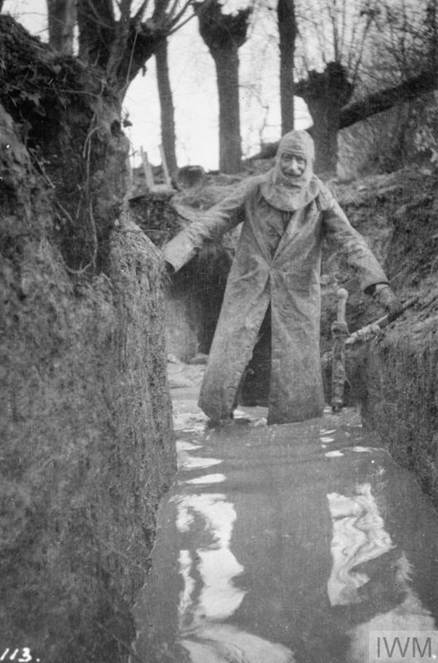
The opening weeks of December 1914 brought no major offensive operations, but the physical conditions in Ploegsteert Wood deteriorated severely due to relentless winter rains. The War Diary recorded the daily struggle to maintain positions:
“1-18 Dec 1914 – During this period there was practically no fighting. The Bn was employed in improving their trenches, owing to the heavy rain the trenches had become flooded and pumps were provided & worked constantly night & day. The trench required to be rebuilt every night owing to the rain. The Coy in the Breastworks were employed in carrying material to the front trench for building purposes. The Coy at PLOEGSTEERT rested for 24 hours but were available for any of the working parties which may be required.”1
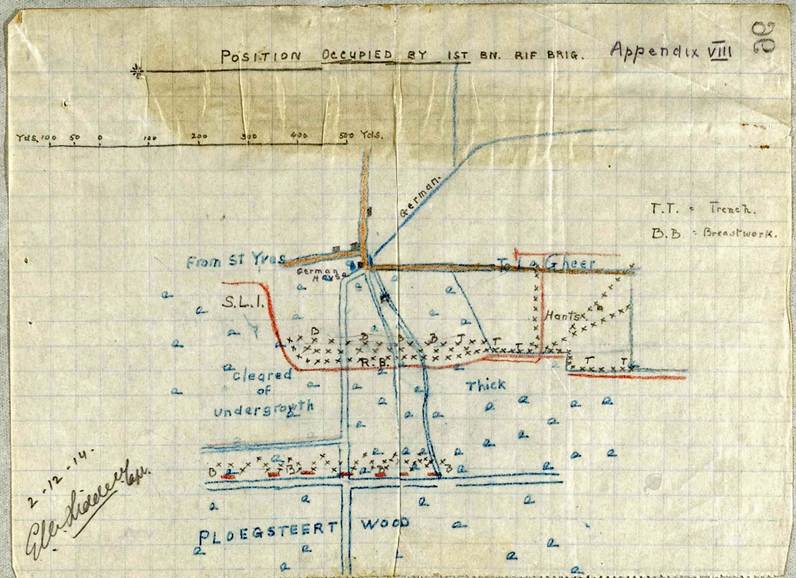
Attack on The Birdcage – 19 December 1914
By cross-referencing the official War Diaries of the 1st Bn, Hampshire Regt2, the 1st Bn, Rifle Brigade3 and the 1st Bn, Somerset Light Infantry4, it is possible to reconstruct the sequence of events on the day Edwin Pike lost his life.
The objective of the operation was to capture a prominent “bight” in the German lines near the edge of Ploegsteert Wood. The 1st Bn, Rifle Brigade and the 1st Bn, Somerset Light Infantry were ordered to lead the main assault, while the 1st Bn, Hampshire Regt were tasked with co-operating on the right flank to suppress enemy fire and advance a detachment to plug a gap at the northern end of their main trench. The London Rifle Brigade was held in reserve.
The Preliminary Bombardment & Artillery Failures
A heavy artillery bombardment commenced at 9:00 am. Although British guns initially made good practice, fatal errors soon developed. Around noon, British artillery shells began falling short, bursting directly over British breastworks and forward trenches. At 11:00 am, an artillery observer visited 1st Bn, Somerset Light Infantry headquarters to verify positions, yet British shrapnel continued to burst directly above the trenches held by the 1st Bn, Hampshire Regt. Between 2:00 pm and 2:20 pm, a Mountain Battery successfully destroyed a strongpoint known as “German House”, but Divisional machine guns failed to breach or clear the heavy German wire entanglements.
The Infantry Assault
At 2:30 pm the 1st Bn, Somerset Light Infantry dashed forward from the cover of the wood, with leading troops carrying straw mattresses in an attempt to bridge the uncut German wire. The attack was shattered almost immediately. Merely 40 yards out, a short-falling British howitzer shell landed directly among the leading right platoon, causing devastating casualties. The left platoon advanced 50 yards before becoming completely pinned down by German crossfire. Subsequent reinforcements could make no headway; by late afternoon, survivors reached the Le Gheer–St Yves Road under cover of darkness but found the trench 3 feet deep in water and exposed to enemy gunfire, rendering it entirely untenable.
The 1st Bn, Rifle Brigade met an equally tragic fate. Rushing out from the wood, they were swept by heavy rifle and machine-gun fire from German earthworks that had survived the artillery bombardment completely unscathed. Their leading officer was killed almost instantly by shellfire from a second German house. Although the 1st Bn, Rifle Brigade succeeded in capturing two German houses, their advance ground to a halt near a fence line in deep mud under heavy fire. On their left, a platoon was virtually decimated among shell holes, water, mud along with both friendly and enemy shellfire. Recognising the futility of further sacrifice, the commanding officer requested permission to halt reinforcements and withdraw.
The Role of the 1st Bn, Hampshire Regiment
On the right, the 1st Bn, Hampshire Regt, were positioned with C Company in the main trench, D Company in the front breastworks and communication trench and A and B Companies in reserve. A designated platoon from D Company stood ready to advance on the right rear of the 1st Bn, Rifle Brigade to seal the gap at the northern end of the main trench. However, as the advancing platoons moved out, they were immediately pinned down by intense German rifle and machine-gun crossfire.
At 5:55 pm, Brigade Headquarters initially ordered all units to hold the ground gained. However, because the captured ground was a flooded swamp that was impossible to entrench, orders were issued to fall back. The shattered battalions withdrew under cover of darkness to their original line in Ploegsteert Wood.
Casualities & Assessment
The assault resulted in zero territorial gain and heavy loss of life. The 1st Bn, Hampshire Regt suffered 1 officer and 15 other ranks killed and 1 officer and 25 other ranks wounded. The 1st Bn, Somerset Light Infantry lost 3 officers killed and 3 officers wounded and missing. The 1st Bn, Rifle Brigade suffered equally severe casualties, losing 2 officers and many other ranks.
The tragic failure was summarised in the war diaries as stemming from the complete failure of the artillery to suppress enemy fire, the rapid loss of leading assault officers, the swamp-like condition of the ground and devastating short-falling shrapnel from friendly guns.
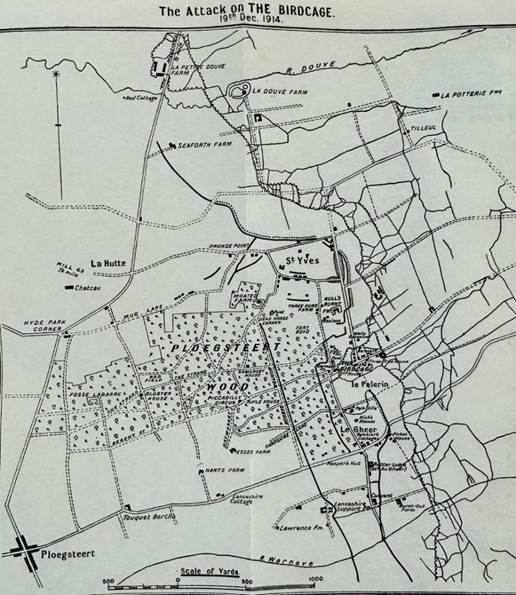
This combined narrative from the three war diaries paints a devastating picture of the conditions experienced that day by the men of the 1st Bn, Hampshire Regt, including Walter Sims, James Pike and Edwin Pike.
Private Arthur Cook of the 1st Bn, Somerset Light Infantry recorded the horror in his diary:
“19 Dec 1914 … Some of our lyddite shells are falling short… Every time we snipe at them they signal a hit, or miss, with a shovel. It is a grim kind of humour! … The noise was deafening, we could not hear ourselves speak… It was a tragic day for the Somersets, for we had nothing in reward for the precious lives thrown away in an attempt to gain a few yards of ground not worth the life of a single Tommy.”6
The remarks column in the 1st Bn, Hampshire War Diary offered a grim confirmation:
“This attack was really stopped by shrapnel from our own guns.”
Private Edwin Pike (1881-1914)
1st Battalion, Hampshire Regiment (Regimental No. 5816)
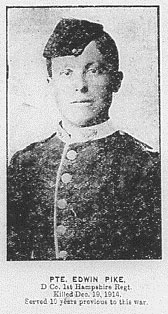
Edwin Pike was born in St Mary Bourne on 17 May 18817, the son of Albert Pike and his wife Ann (nee Gibbons) and was baptised at the Primitive Methodist Chapel on 15 July 18818.
A veteran soldier, Edwin first enlisted in the Hampshire Regt in late 18999. He served overseas during the Second Boer War (1899–1902) with the 2nd Bn, earning the Queen’s South Africa Medal10 with Transvaal, South Africa 1901 and South Africa 1902 clasps. He subsequently saw active service in East Africa during the Somaliland Campaign (1902–1904) with the 1st Bn, earning the Africa General Service Medal11 with Somaliland and Jidballi clasps. After completing six years of active service, he was transferred to the Army Reserve c. 1905.
Returning to civilian life, Edwin gained employment with the London & South Western Railway in June 190912 as an engine cleaner at Wimbledon Park, later receiving a promotion in 1912 to railway porter at Templecombe station.
Recalled in August 1914, Edwin reached the front lines in France on 5 September 1914 with the battalion’s first draft of reinforcements. Assigned to D Company, he was reunited near the front with his younger brother, James, who was also serving in the battalion.
On 19 December 1914, while serving with D Company during the assault against German positions at ‘The Birdcage’, Edwin was killed in action at the age of 33. He was laid to rest at Lancashire Cottage Cemetery in Belgium.
In addition to his Boer War and Somaliland decorations, Edwin was posthumously awarded the 1914 Star, the British War Medal and the Victory Medal[15].
A contemporary local report recorded the family’s tragic loss:
“ANOTHER.—Out of a total of three fatalities from the local Roll of Honour, Lower Rank now owns the loss of two brave sons. The latest on the list is that of Pte. Edwin Pike, of D Co., 1st Hants, of whom news has just been officially received as having been killed in action on Dec. 19. He is the third son of the late Albert Pike and of Mrs. Pike, and was called up in August after having served about 10 years on the reserve, previous to which he had taken part in the Boer War. His brother James, of the same regiment, has just recovered from wounds which necessitated his entry into hospital. The deceased’s last letter, which bore the Censor’s date stamp Dec. 17, mentioned that he had seen Jim two or three days ago,” when they were both all right. Edwin, who used to work locally some years ago, had latterly been a porter at Templecombe, and had also worked at Wimbledon. It seems a very strange coincidence that all three St. Mary Bourne deceased warriors should be in the same regiment. Our sympathies go with Mrs. Pike in her severe loss.”13
The Christmas Truce of 1914
By late December 1914, following the tragic loss of Frederick Day, Sydney Gunnell and Edwin Pike, only two of the five St Mary Bourne reservists remained with the 1st Bn in Ploegsteert Wood: Walter Sims and James Pike.
While the War Diary of the 1st Bn, Hampshire Regt offers limited detail on the event, cross-referencing the diaries of the 1st Bn, Somerset Light Infantry and the 1st Bn, Rifle Brigade alongside first-hand accounts from Hampshire soldiers provides a detailed picture of the historic Christmas Truce as experienced by Walter and James.
An Informal Cessation of Hostilities
The truce began on the night of 24 December through musical and vocal exchanges across No Man’s Land, lasting until New Year’s Eve. The Somerset Light Infantry war diary recorded “much singing” from both sides, which escalated when German forces brought a regimental band into their trenches to play national anthems and “Home, Sweet Home”.
By Christmas morning, an informal truce was mutually arranged, with officers meeting halfway in No Man’s Land to establish terms. Soldiers mingled freely to exchange cigarettes and cigars, while official holiday cards from Their Majesties and Princess Mary’s gift tins were distributed to the British ranks. The truce also provided a vital opportunity to recover and bury the dead left in No Man’s Land, as well as to repair and fortify flooded trenches.
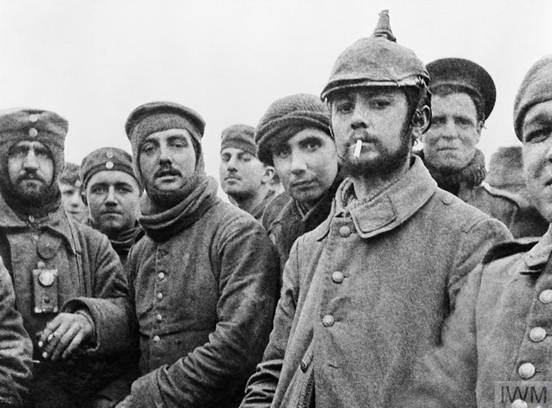
Private Edward Roe of the 1st Bn, East Lancashire Regt recorded the astonishment in the trenches on Christmas morning:
“25 Dec 1914 … at 5.00 am word had passed down the trench that the Hampshires and the Germans were out fraternizing in no-man’s-land. ‘Impossible, who’s leg are you pulling?’ ‘If you don’t believe me, go down and see for yourself’? And there they were, sure enough, British and German warriors in no-man’sland, unarmed, talking to each other and exchanging souvenirs. There is a Christ after all.”15
First-Hand Accounts from the 1st Bn, Hampshire Regiment
Private B. Hutchings of B Company, 1st Bn, Hampshire Regt, described meeting German soldiers halfway between the trenches:
“The Saxon Cap Badge was given to me with a cigar in exchange for my own in Xmas 1914 at Plougstreet Wood. The German Trenches were roughly 200 yds from ours.
Our Company Officers Name was Capt. Unwin. The Saxon’s were beckoning with their hands for us to go over to their trench. But we shouted over that we would meet them half way so Capt Unwin asked for a volunteer. I happened to be standing by the side of him at the time and it fell my lot to go over and meet one of the Saxon’s and a nice fellow he was. We shook hands and his first words to me was Were there any Scotch Territorials out yet as he was himself a waiter in Glasgow. After that I cannot remember what was passed between us as their was quite a little crowd of us. But we were the best of friends for the next seven days. We use to walk about on top of the trench or in the front of it without any thing happening I remember one day during the truce they accidentally killed one of our HQ Siggnlars and they sent over and appologized and the last day of the truce, one of their fellows brought over a message to say they had orders to open fire with their auto matic machines but their first shots would be fired high. Capt Unwin in return gave him a box of chocolates. And they certainly acted according to message. Then we were at war again I mentioned Saxon’s as they are to be relieved by The Prussians.
Capt Unwin I believe was killed about the same time as Capt Fiddler our late RSM 2nd Battle of Ypres I remember him so well. I walked into him after the retire next I was walking along asleep.”16
A letter published in the local press from Bandsman Fred Brewer, a stretcher-bearer with the 1st Bn, Hampshire Regt, captured how the battalion spent Christmas Day:
“LETTERS FROM THE FRONT.
1st Hants Regt.,
Jan. 8, 1915.DEAR SIR,—I thought I, as a stretcher bearer, would write a few lines as to how the lads spent Christmas. On Christmas Eve we heard a lot of shouting and singing in the trenches, and inquiring what it was we found that the lads were wishing the Germans a merry Christmas and just enjoying themselves, and when two of my chums went up to relieve the other two that were in the trenches the day before, we always have two stretcher bearers in the trenches to attend to the wounded, and the two that went to relieve the others, they found the trenches decorated by Chinese lanterns, and the Germans had a band in their trenches, and the men sang while the band played, and of course our lads had to join in, the singing was lovely, and on Christmas Day the Germans came out of their trenches and walked across towards ours, and the captain of the company went to see what they wanted, and he found that they wanted to have a day’s peace to bury their dead, so they agreed to have a truce for the day, and then the men went out in front of the trench and exchanged cigarettes for cigars, and then our stretcher bearers and some of the Company men helped them (the Germans) to bury their dead, and after the service the officer that conducted it thanked the English for helping them, so we had an enjoyable time, it was a treat to walk about without having to dodge the bullets and shells, but of course the truce didn’t last long, and now we are at in earnest again. All the lads are lively and in good spirit.—Wishing your paper every success, I remain, yours truly,
Bandsman FRED BREWER
(Stretcher Bearer).”17
As James Pike had previously served as a bandsman during his regular army service in South Africa, he likely served in a similar role as a stretcher-bearer alongside Fred Brewer during these events.
January 1915: Winter Conditions in the Trenches
Following the resumption of hostilities after the Christmas Truce, the physical conditions in Ploegsteert Wood remained exceedingly harsh. The weather staying very wet until the end of the month, but not too cold. The conditions in the trenches steadily improved over the month with more pumps available. The Germans shelled the wood most day with their howitzers, field guns and a light gun nicknamed “Little Willie”18.
“Spending hours in wet and muddy trenches was a constant cause of sickness, though from January extra rations, pea soup and more tea and sugar, were issued to men actually in the trenches. Though rheumatism and bronchitis were prevalent with a lot of ‘trench feet’ and frost bite, for which new remedies had to be devised, pneumonia cases were remarkably few, and the admissions to hospital, 150 in January, 120 in February and 100 in March, were not as high as might have been feared.”19
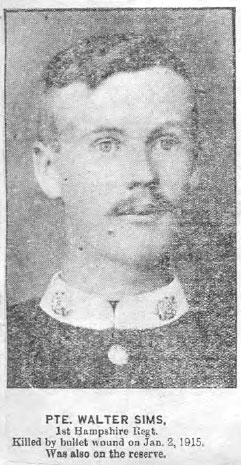
Private Walter Sims (1878-1915)
1st Battalion, Hampshire Regiment (Regimental No. 5718)
Walter Sims was born at Leigh (Lye) Farm, Binley, in the parish of St Mary Bourne, on 17 September 187821, the son of Walter Sims and his wife Mary (nee Bevis) and was baptised at the Primitive Methodist Chapel on 1 November 187822.
A veteran with a long military background, Walter first enlisted in the 3rd Bn, Hampshire Regt in 189723, before re-attesting for regular service on 20 July 189924. Posted to the 2nd Bn, he deployed to South Africa during the Second Boer War, earning the Queen’s South Africa Medal25 (with Cape Colony, Orange Free State and Transvaal clasps) and the King’s South Africa Medal26 (with 1901 and 1902 clasps). Upon completing his active service around 1905, he returned home to St Mary Bourne to work as a farm labourer and was placed on the Army Reserve.
On 5 August 191427 the day of his father’s funeral Walter received his recall orders and departed for the Hampshire Regiment depot in Winchester. Having missed the opening mobile battles of August, he reached the front line in France with the third draft of reinforcements on 24 September 1914, joining his fellow village reservists in the emerging routine of trench warfare. In late December 1914, while holding trenches in Ploegsteert Wood, Walter was among the troops who participated in the historic Christmas Truce, meeting German soldiers in No Man’s Land during the temporary cessation of hostilities.
On 2 January 1915, shortly after hostilities resumed, Walter was killed in action by a bullet wound to the head while on trench duty. He was 36 years old and became the fourth reservist from St Mary Bourne to fall.
Walter was laid to rest at Lancashire Cottage Cemetery in Belgium. He was posthumously awarded the 1914 Star, the British War Medal and the Victory Medal28.
News of Walter’s death reached St Mary Bourne through a personal letter of condolence sent by his Company Captain to his widowed mother:
“AND ANOTHER. — This week the parishioners have lamented the loss of yet another of their brave sons at the front, in the person of Pte. Walter Sims, also of the 1st Hants Regt. The news was received by his widowed mother, through the agency of a letter from the captain of deceased’s company, who stated he was killed by a bullet wound in the head on Jan. 2, and was buried the next day in the little regimental graveyard, the service being conducted by the chaplain. A memorial service was held in St. Peter’s Church on Sunday, when in the course of his sermon the Rev. P. E. Binns read a portion of the letter as follows: “I hope it will be a consolation to you to know that your son won for himself a reputation as a man fearless under fire, who could be counted on to go unquestioningly through anything. I considered him one of the most reliable and best men in the company, and talking of him to my sergeant-major only the day before he remarked that Pte. Sims was one of those quite fellows that was always there when wanted and nothing came amiss to him.” Before the blessing a suitable hymn was sung, and the usual prayers were read. After the blessing the organist, Mr. A. H. White, played a funeral march from “The Story of Sayid.” It might be added that Pte. Sims’ father died on the very day his son was called up. Sims was on the reserve, and a chum of the other three warriors whose deaths have been previously recorded.”29
February – March 1915: Routine in the Trenches
The period covering February and March 1915 proved significantly quieter than the opening months of the war. For both months, the 1st Bn, Hampshire Regt’s War Diary recorded only a single summary entry.
Although the battalion came under artillery fire from German guns, casualties remained low. The men spent much of their time maintaining and improving their positions, which required continuous pumping to clear out water from the flooded trenches. During this time, a new rotation system was implemented: after spending six days at the front line, the battalion was relieved to spend six days in support and reserve.
By this stage, Private / Bandsman James Pike was the sole survivor among the five St Mary Bourne reservists serving with the 1st Bn on the Western Front. On 3 March 191530, James was sent to the 4th Stationary Hospital to receive treatment for an abscess on his neck. Following nine days of medical care, he recovered and returned to his comrades in the trenches on 12 March 1915.
April 1915: The Second Battle of Ypres (Battle of St Julien) & The Loss of the Last Reservist
In April 1915, the 1st Bn, Hampshire Regt moved out from Ploegsteert Wood to relieve Canadian forces near Zonnebeke at the onset of the Battle of St Julien (24 April – 4 May 1915), one of the key engagements of the Second Battle of Ypres. Upon arrival, the battalion found that Canadian troops had abandoned their positions, leaving the 7th Fusiliers exposed on their flank.
On the night of 25 April 1915, they began digging in within an area of partially completed trenches. A thick morning fog on 26 April granted them an extra hour of cover to dig, but once the fog lifted, German forces opened an intense artillery bombardment that lasted for hours.
It was during this heavy shelling that the role of regimental bandsmen became vital on the battlefield:
“The stretcher-bearers were usually men from the regimental band.
Stretcher-bearers had the most hazardous duties; their daily task was to recover wounded and dead men from no man’s land usually under artillery fire… carried only basic medical kits comprising bandages and morphine to kill the pain”31
While no surviving records state his specific duty on that day with absolute certainty, it is known that James Pike was a regimental bandsman, making it highly probable that he was serving in this hazardous role as a stretcher-bearer, recovering wounded comrades under heavy artillery fire when he was killed.
Private / Bandsman James Pike (1884-1915)
1st Battalion, Hampshire Regiment (Regimental No. 7390)
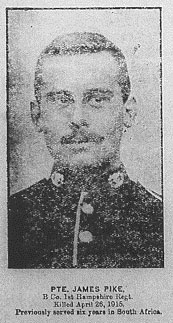
James Pike was born in St Mary Bourne on 3 January 188432, the son of George Pike and his wife Ann (nee Gibbons) and the younger brother of Edwin Pike. He was baptised at the Wesleyan Methodist Chapel on 25 March 188433.
A former regular soldier, James attested for service with the Hampshire Regt in the mid-1900s34 and served six years in South Africa. As a member of the regimental band, he served alongside Frederick Day at Wynberg35 and Sydney Gunnell with the 2nd Mounted Infantry. After completing his active service and transferring to the Army Reserve, James moved to Darlington, County Durham. It was in Darlington that he met Hilda Harrison whom he married on 24 March 191336. He found work as a foundry labourer and the couple welcomed a son Herbert on 31 Jan 191437.
Recalled to the colours upon mobilisation in August 1914, James left behind his wife and infant son to rejoin the 1st Battalion, landing at Le Havre on 23 August 1914. He endured the opening mobile campaigns of the Western Front including the Retreat from Mons, the stand at Le Cateau, the Battle of the Marne and the trench fighting along the Aisne. On 5 September 1914, he was reunited near the front with his elder brother Edwin. After recovering from wounds sustained in late autumn 1914, James saw Edwin again in mid-December, just days before Edwin was killed at ‘The Birdcage’ on 19 December 1914.
On 3 March 1915, James was sent to the 4th Stationary Hospital to receive treatment for an abscess on his neck. Following nine days of medical care, he recovered and returned to the trenches on 12 March 1915.
In late April, during the intense, hours long German artillery bombardment near Zonnebeke, James Pike was killed in action on 26 April 1915 at the age of 31. He was the last of the five reservists from St Mary Bourne to fall and the second son lost by his widowed mother, Ann Pike, within four months.
Having no known grave, James is commemorated on the Menin Gate Memorial at Ypres, Belgium. He was posthumously awarded the 1914 Star, the British War Medal and the Victory Medal38.
A contemporary local report recorded the village’s sorrow at his loss:
“THE ROLL OF HONOUR.—The tragic-toned echoes of the great European war were wafted to this village for the sixth time on Monday, bringing with them the sad news of the death in action of James Pike, whose widowed mother resides at Lower Rank. This makes the sixth brave son who has laid down his life for those at home, the five preceding names being as below: Frederick Day, Sidney Gunnell, Harold Moorse, Edwin Pike, Walter Sims, from which one is reminded of the saying “It never rains but it pours,” for this last casualty is the second one in the same home. The little village had previous to the war seven men on the reserve of the 1st Hants Regt., and up to the time of writing only one remains unbeaten in the game of war. Pte. James Pike was killed on April 26. A letter received by his bereaved mother dated April 19 said he was quite well, but was afraid he would not be able to write so often owing to being shifted. On the 25th ult., or one day before his death, the usual official postcard also stated he was quite well. Like his other village comrades who have passed beyond the veil, Jim had seen service in South Africa, where he spent six years. On arriving home he went to a Darlington factory to work, and had been there over two years. Here a good job was being kept open for him if he could have returned. He leaves a widow and a baby boy.”39
The Last Post
In August 1914, the announcement of mobilisation caused immediate anxiety for the rural parish of St Mary Bourne, arriving at the crucial start of the harvest season. Five men were called up from the Army Reserve to rejoin the 1st Battalion, Hampshire Regt: local village men Frederick George Day, Sydney Gunnell and Walter Sims, alongside brothers Edwin Pike and James Pike, former inhabitants of the parish and sons of local widow Ann Pike. Departing for the front line, these men joined the British Expeditionary Force in France and were immediately drawn into the opening mobile battles of the Western Front covering the Retreat from Mons and standing ground at Le Cateau, the Marne and the Aisne.
By the autumn of 1914, the battalion had taken up positions in and around Ploegsteert Wood, where the harsh reality of trench warfare took a heavy toll:
- Private Frederick George Day fell during the defence of Ploegsteert Wood between 30 October and 2 November 1914.
- Private Sydney Gunnell was killed on sentry duty by a German sniper on 23 November 1914.
- Private Edwin Pike was killed on 19 December 1914 during the ill-fated assault on “The Birdcage”.
- Private Walter Sims, having survived the historic Christmas Truce in No Man’s Land, was shot on trench duty on 2 January 1915.
- Private / Bandsman James Pike was killed during an intense artillery bombardment near Zonnebeke on 26 April 1915 during the Second Battle of Ypres.
By late April 1915, all five reservists—alongside Lt. Harold Moorse of the 1st Bn, York and Lancaster Regiment had lost their lives: six men from the parish killed within the space of just nine months.
Communal Loss and Remembrance
As official notices and telegrams arrived in Hampshire, the heartbroken community of St Mary Bourne turned to St Peter’s Church as a sanctuary for collective mourning. The vicar, Rev. P. E. Binns, conducted solemn memorial services that brought the distant tragedy of the front line directly to the parish pulpit. These services provided vital solace to families facing devastating double losses, such as the widowed Mrs. Ann Pike, who lost both of her sons, Edwin and James, in the space of just four months.
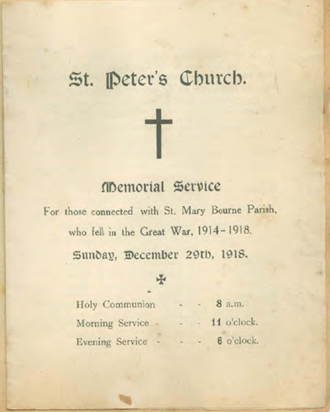
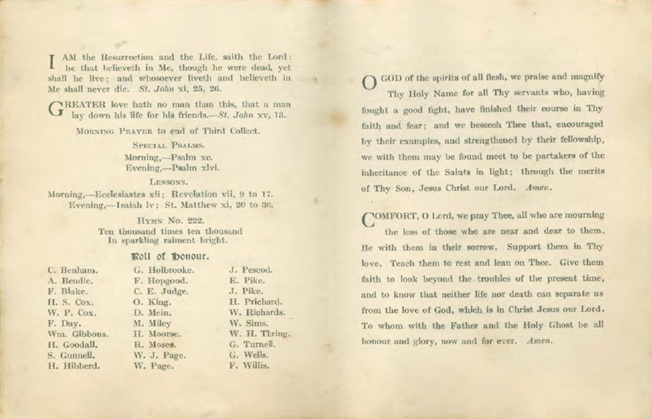
When peace finally returned, a parish memorial service40 was held on 29 December 1918 at St Peter’s Church, where all five reservists were commemorated alongside others who had fallen during the conflict.
When the parish erected the St Mary Bourne War Memorial, the names of all five reservists were inscribed alongside their fallen neighbours, standing as a permanent testament to the 37 men of the parish who gave their lives.
- Buried in Belgium: Sydney Gunnell, Edwin Pike and Walter Sims lie buried in foreign soil at Lancashire Cottage Cemetery.
- No Known Grave: Frederick Day and James Pike are commemorated on the memorials to the missing Frederick George Day on the Ploegsteert Memorial and James Pike on the Menin Gate Memorial in Ypres.
Traditionally signifying the conclusion of daily duty and the soldier’s final rest, the sounding of ‘The Last Post’ forms an enduring link between St Peter’s Church in St Mary Bourne and the battlefields of Flanders, where the five reservists of the Hampshire Regiment now lie.
- Officers of the 1st Bn. The Hampshire Regiment. (Aug 1914-Apr 1915). War Diary of the 1st Bn. The Hampshire Regiment. The National Archives. Retrieved from www.ancestry.co.uk ↩︎
- Officers of the 1st Bn. The Hampshire Regiment. (Aug 1914-Apr 1915). War Diary of the 1st Bn. The Hampshire Regiment. The National Archives. Retrieved from www.ancestry.co.uk ↩︎
- Officers of the 1st Bn. The Rifle Brigade. (Dec 1914). War Diary of the 1st Bn. The Rifle Brigade. The National Archives. Retrieved from www.Ancestry.co.uk ↩︎
- Officers of the 1st Bn. The Somerset Light Infantry. (Extracts Oct, Nov & Dec 1914). War Diary of the 1st Bn. The Somerset Light Infantry. The National Archives. Retrieved from www.ancestry.co.uk ↩︎
- https://www.walkingthebattlefields.com/2026/02/a-walk-in-ploegsteert-plugstreet-wood.html ↩︎
- Gillard, B. (2004). Good Old Somersets, An ‘Old Contemptible’ Battalion in 1914. Leicester: Matadoor, pp. 143-144. ↩︎
- Edwin Pike, Birth Certificate, registered: Q2 1881 Whitchurch (Hampshire), Vol. 2C, Pg. 209, General Register Office. ↩︎
- Edwin Pike, baptism, 1881, Andover Primitive Methodist Circuit, Hampshire, England, Nonconformist Registers, 1835-1921 (available at www.ancestry.co.uk), 96M72/NMC/R8, original data: Hampshire Archives & Local Studies, accessed: February 2026. ↩︎
- Hampshire Regiment – 1st & 2nd Battalions, https://armyservicenumbers.blogspot.com/2012/02/hampshire-regiment-1st-2nd-battalions.html, accessed: February 2026 ↩︎
- E Pike, UK, Military Campaign Medal and Award Rolls, 1793-1949 (available at www.ancestry.co.uk ), original data: The National Archives, Regimental No. 5816, 2nd Battalion Hampshire, Queen’s South Africa Medal, WO 100/187, accessed: February 2026. ↩︎
- E Pike, UK, Military Campaign Medal and Award Rolls, 1793-1949 (available at www.ancestry.co.uk ), original data: The National Archives, Regimental No. 5816, 1st Battalion Hampshire, African General Service Medal, WO 100/100, accessed: February 2026. ↩︎
- Edwin Pike, UK, Railway Employment Records, 1833-1956 (available at www.ancestry.co.uk ), original data: The National Archives, London and South Western, Register of wages staff 1893 – 1927, RAIL411/512, accessed: February 2026. ↩︎
- 8 January 1915, St Mary Bourne, Andover Advertiser, Andover, microfilm, accessed: 2014 ↩︎
- Imperial War Museum, Catalogue No. Q 11745 ↩︎
- Roe, E. (2004). Diary of an Old Contemptible (Kindle ed.). (P. Downham, Ed.) Barnsley: Pen & Sword Books. Chapter VII, Christmas 1914 and Life in ‘Plugstreet’ ↩︎
- https://www.royalhampshireregiment.org/the-christmas-truce-of-1914/ Note: the website states the transcription is in his own spelling. ↩︎
- 15 January 1915, Letters from the front, Andover Advertiser, Andover, microfilm, accessed: 2014 ↩︎
- Officers of the 1st Bn. The Hampshire Regiment. (Aug 1914-Apr 1915). War Diary of the 1st Bn. The Hampshire Regiment. The National Archives. Retrieved from www.ancestry.co.uk ↩︎
- Atkinson, C. (1952). The Royal Hampshire Regiment 1914-1918 (Kindle ed., Vol. Two). Glasgow: The University Press. Chapter III. ↩︎
- Imperial War Museum, Catalogue No. Q 51569 ↩︎
- Walter Sims, Birth Certificate, registered: Q4 1878 Whitchurch, 2C/208, General Register Office. ↩︎
- Walter Simms, baptism, 1878, Andover Primitive Methodist Circuit, Hampshire, England, Nonconformist Registers, 1835-1921 (available at www.ancestry.co.uk), 96M72/NMC/R8, original data: Hampshire Archives & Local Studies, accessed: November 2024. ↩︎
- Walter Sims, British Army Service Records (available at www.findmypast.co.uk ), original data: The National Archives, Regimental No. 7970, Hampshire Regiment, Attested: 15 Feb 1897, WO 96/651 box 83, accessed: March 2026. ↩︎
- Walter Sims, British Army Service Records (available at www.findmypast.co.uk ), original data: The National Archives, Regimental No. 8980, Hampshire Regiment, Attested: 20 Jul 1899, WO 96/651 box 84, accessed: March 2026. ↩︎
- W Sims, UK, Military Campaign Medal and Award Rolls, 1793-1949 (available at www.ancestry.co.uk ), original data: The National Archives, Regimental No. 5718, 2nd Battalion Hampshire, WO 100/187, Queen’s South Africa Medal, accessed: March 2026. ↩︎
- W Sims, UK, Military Campaign Medal and Award Rolls, 1793-1949 (available at www.ancestry.co.uk ), original data: The National Archives, Regimental No. 5718, 2nd Battalion Hampshire, WO 100/332, King’s South Africa Medal, accessed: March 2026. ↩︎
- Walter Sims, bur. 5 Aug 1914, Extracts from the Burial Register of St Mary Bourne, original document, Provided by Revd M.A. Coppen, 16 Nov 2008, St Peter’s Church, St Mary Bourne, accessed: November 2008. ↩︎
- Walter Sims, UK, British Army World War I Medal Rolls Index Cards, 1914-1920 (available at www.ancestry.co.uk ), original data: The Western Front Association, Regimental No. 5718, Hampshire Regiment, accessed: March 2026. ↩︎
- 15 January 1915, St Mary Bourne, Andover Advertiser, Andover, microfilm, accessed: 2014 ↩︎
- James Pike, UK, WWI Hospital Registers, 1915-1919 (available at www.fold3.com ), original data: The National Archives, Regimental No. 7390, 1st Hampshire Regiment, MH 106/1397, accessed: March 2026. ↩︎
- Waller, I. H. (2024). Introducing Health Care in Times Past. How our ancestors coped with illness and death. Volume 4: Military Medical Care. Sheringham: Family History Books, pp. 39. ↩︎
- James Pike, Birth Certificate, registered: Q1 1884 Whitchurch (Hampshire), Vol. 2C, Pg. 207, General Register Office. ↩︎
- James Pike, baptism, 1884, Andover Wesleyan Circuit, Hampshire, England, Nonconformist Registers, 1835-1921 (available at www.ancestry.co.uk), 96M72/NMC/R3, Pg. 53, No. 193, original data: Hampshire Archives & Local Studies, accessed: March 2026. ↩︎
- Hampshire Regiment – 1st & 2nd Battalions, https://armyservicenumbers.blogspot.com/2012/02/hampshire-regiment-1st-2nd-battalions.html, accessed: Feb 2026. ↩︎
- James Pike, 1911 Census for England & Wales (available at www.findmypast.co.uk), reference: RG14 piece 34976, schedule 9999, original data: The National Archives, accessed: March 2026. ↩︎
- James Pike, Marriage Certificate, registered: Q1 1913, Darlington, Vol. 10A, Pg. 24, General Register Office. ↩︎
- Herbert Pike, Birth Certificate, registered: Q1 1914 Darlington, Vol. 10A, Pg. 65, General Register Office. ↩︎
- James Pike, UK, British Army World War I Medal Rolls Index Cards, 1914-1920 (available at www.ancestry.co.uk ), original data: The Western Front Association, Regimental No. 7390, Hampshire Regiment, accessed: March 2026. ↩︎
- 21 May January 1915, St Mary Bourne, Andover Advertiser, Andover, microfilm, accessed: 2014 ↩︎
- From Mrs Spankie’s Scrapbook, St Mary Bourne Parish Archives, Vol. 1 available on DVD published 2010. ↩︎